If you’re a CRE owner, you’re already familiar with performing due diligence on new properties, tenants, leases, as well as navigating the gamut of capital and operating considerations in the pursuit of maximizing returns from your assets.
In the era of expensive and scarce electricity, energy diligence is the next item on the list.
If you’re also a frequent reader of SolarKal’s content, you may be familiar with the high-level concepts of performing due diligence on solar and storage. In this SolarKal Quarterly, we dive deeper into CRE must-dos to best prepare assets for the next 10 years of competition, focusing on both solar and storage and identifying the one thing that forward-thinking industry leaders are incorporating into their leases to best prepare.
Historically, energy diligence meant reviewing utility bills and estimating future operating costs. That is no longer enough. A building’s roof, meter, utility tariff, tenant structure, and lease language can all affect whether energy is simply an expense or a source of value.
Electricity costs are rising in many markets as tenants are using more power and utilities are facing new grid constraints. At the same time, benchmarking rules, investor expectations, and tenant sustainability goals are making energy performance a more visible part of asset management.
In response, industry leaders have learned to monetize their underutilized roofs and utility access to add valuable NOI and reduce expenses by leveraging both solar and storage solutions. Deployment of solar has been the fastest in history, and for the first time, states are heavily incentivizing commercial-scale storage.
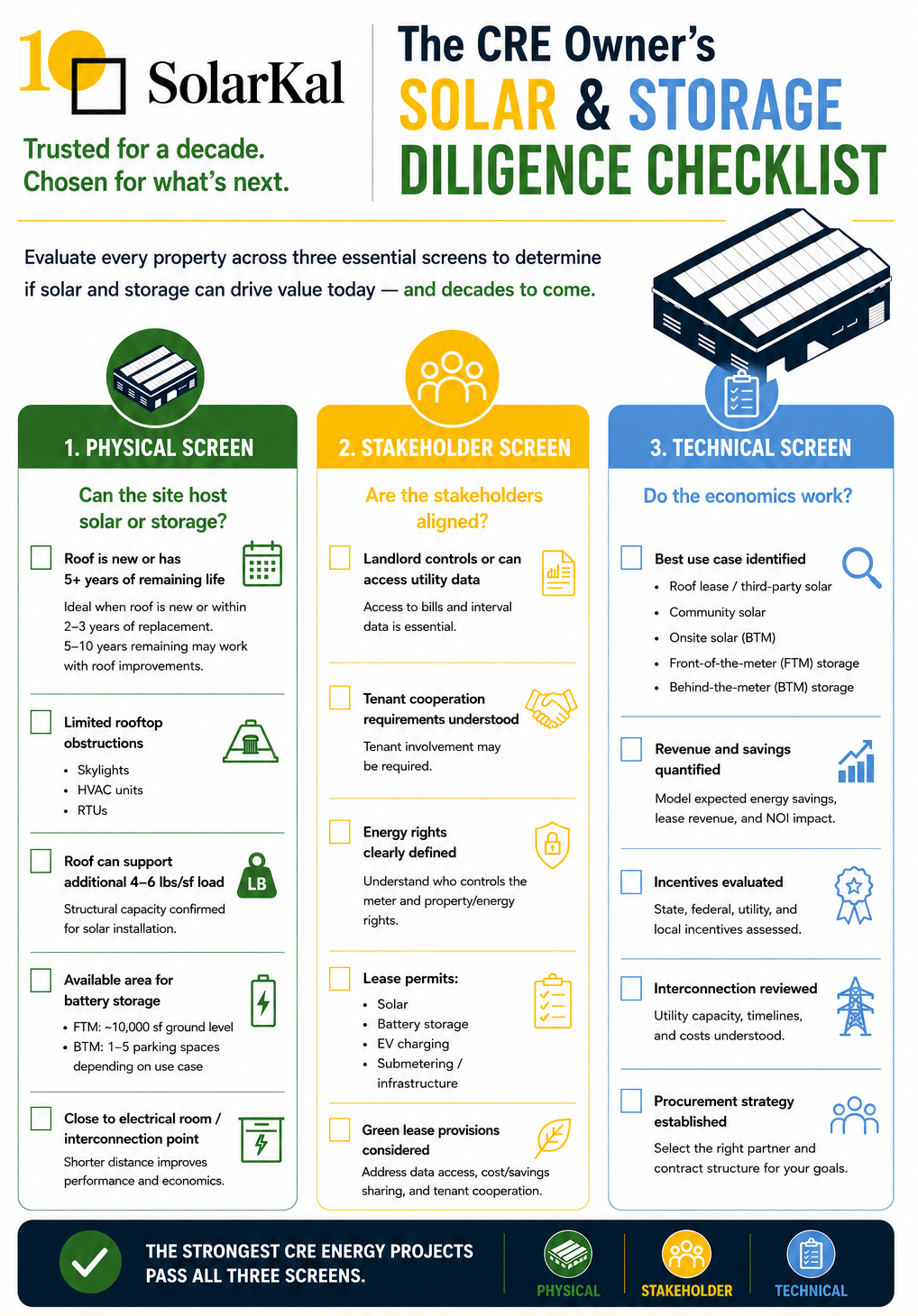
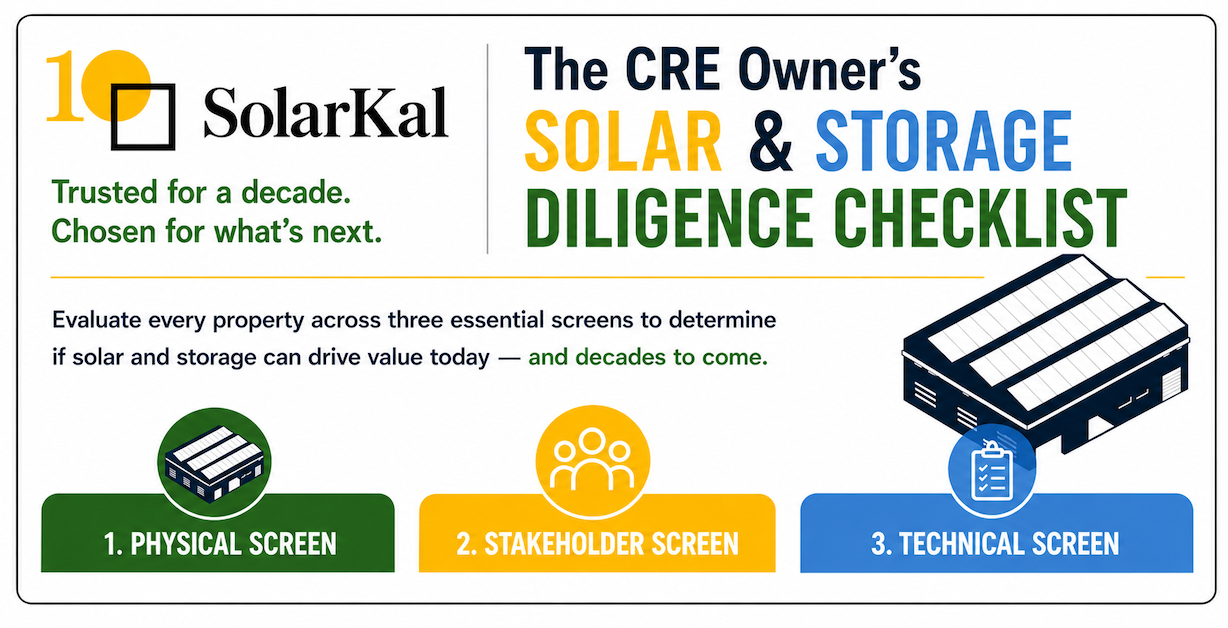
For buyers, this paradigm shift has altered the property diligence process. Solar and storage potential should be evaluated across three categories: physical, stakeholder, and technical.
For solar, the three largest diligence factors buyers need to understand are roof age, roof condition, and structural capacity.
For battery storage, the biggest limiting factor is size; systems are sized differently depending on whether the system is front-of-the-meter (FTM) or behind-the-meter (BTM).
This is often the most underappreciated arena.
Solar and batteries do not create value in the abstract. They create value through a meter, a utility tariff, and a contract. In commercial real estate, the building owner is not always the party that controls the meter, pays the bill, receives the data, or captures the savings.
That is especially true in triple-net industrial and retail properties, where tenants often pay utility bills directly. From a traditional real estate perspective, that may be attractive because energy cost volatility sits with the tenant. But from an energy strategy perspective, it can create blind spots and limitations:
The last bullet is the single biggest impediment for behind-the-meter (BTM) use cases and why SolarKal’s clients have historically often chosen front-of-the-meter (FTM) projects owned by a third party with the system providing rent in the form of NOI-boosting lease payments that increase property values.
Critically, the list of options available to each property depends on the setup here. As industry-leaders have become more attuned to their properties’ energy profiles, buyers have begun asking key questions as part of an energy rights review during acquisition diligence:
These may sound like legal details, but they determine the practical menu of energy options available to the owner. The landlord–tenant relationship can decide whether solar or storage value is accessible, shareable, or stranded.
That is why many forward-thinking owners are beginning to incorporate “green amendments” into their tenant leases. Green amendments address utility-data access, roof and equipment rights, tenant cooperation, and cost/savings allocations. SolarKal works with its clients to implement these amendments and put the optionality back in the owner’s hands.
The technical screen is where the opportunity becomes a project. For solar and storage, the first question is the use case: Is the asset best suited for a roof lease, on-site solar, community solar, FTM storage, BTM storage, or no project at all? From there, the analysis turns to utility rates, meter configuration, demand charges, incentive eligibility, interconnection costs, procurement, and, finally, ultimate economics.
This is the most familiar part for SolarKal readers as we often discuss economics and risks, so we’ll be brief here.
Experience in navigating development and financing hurdles is critical; specifically, vendor procurement, project development, incentive applications, and interconnection processes are all significant sources of project conversion risks. Projects often hit at least one hurdle here, and the ability to navigate these hurdles is often the difference that SolarKal brings to the process to result in a successful project.
Looking Forward
The next decade of CRE competition will not only be defined by location, rent, and traditional capex planning but also by power availability, energy costs, and tenant sustainability requirements. On-site energy infrastructure will shape asset performance. Owners who want to capture that value need more than good roofs or open spaces, they need the data, rights, and lease structures that allow them to act.
SolarKal helps CRE owners evaluate solar and storage opportunities across physical, stakeholder, and technical areas to ensure your assets are prepared not just for today’s energy market but for the next decade of CRE competition.
Get SolarKal's CRE Solar & Storage Checklist.