Solar and battery storage don’t automatically make a property more valuable simply because they’re "green." Instead, they create value by generating durable cash flow, reducing operating costs, and improving the long-term competitiveness of an asset. The key is ensuring those benefits are structured in a way that preserves flexibility for refinancing, recapitalizations, and future property sales.
That distinction matters because solar and storage projects involve significant financial commitments and long-term property rights. Lease provisions, lender consents, roof obligations, insurance requirements, equipment removal, and assignment rights all influence whether a project enhances an asset, or creates unnecessary transaction friction.
Anthony Saladino, President and CFO of Plymouth Industrial REIT and SolarKal advisor, recently explained the owner’s perspective during a ULI Greenprint webinar:
Our goal is obviously to maximize long-term value, and build in flexibility for the real estate because we routinely evaluate refinancing opportunities, recapitalizations, and asset sales.
When handled correctly, a solar installation can become an additive part of the property rather than an encumbrance. As Saladino put it:
What we have found [is], if structured properly, a solar lease functions much like a quality long-term tenant, generating predictable cash flows that transfer seamlessly with the property, and in our view, enhances value rather than creating transactional friction.
Understanding how those factors affect valuation requires looking at a property through both a financial and an operational lens.
From a financial perspective, solar and battery storage create commercial property value when they produce durable, transferable property-level cash flows or reduce operating costs and risks that matter to tenants, lenders, and future buyers.
Solar is valuable because it replaces electricity that would otherwise be purchased from the utility. When the avoided utility rate increases, the value of every kilowatt-hour generated on-site also increases. A battery is valuable as it drastically reduces operating costs by shaving costs associated with the critically expensive “peak hours,” when utility rates and demand charges are highest, without adjustments to operations.
For a landlord paying the electricity bill, those savings can flow directly into net operating income (NOI). For a tenant-paid property, lower energy costs may improve total occupancy costs, tenant retention, and the competitiveness of the building. Installing both types of systems can also have the added benefit of hedging against future increases in electricity prices.
The challenge, however, is translating that benefit into recognized property value. As long as a property retains its marketability and flexibility, buyers and appraisers are more likely to assign value to documented annual savings and contracted grid revenue than to a general claim that it is "more resilient.
A solar lease can create meaningful property value by generating a long-term contractual income stream that is capitalized alongside the rest of the property’s NOI. In effect, an otherwise unused roof begins to perform like another income-producing area of the asset.
In 2024, we explained how rooftop solar can increase commercial property value by increasing NOI in our article, Could Solar Be the Valuation Game-Changer You Need? That valuation framework remains just as relevant today.
What has changed is the market around it. Lease payments have generally increased as electricity prices have risen and developer competition has intensified, while capitalization rates have shifted differently across major real estate markets. Together, those changes affect how much value a solar project may add to an individual property.
The valuation framework is straightforward:
Property Value = Net Operating Income ÷ Capitalization Rate
We highlighted three ways solar can improve asset economics:
Each structure can increase NOI either by increasing revenue or reducing operating expenses. That additional NOI can then be capitalized into property value. Updating our 2024 solar roof lease examples using data from SolarKal’s marketplace in Q2 2026 and CBRE’s latest Cap Rate Survey illustrates how economics have shifted: Lease rates have largely increased since 2024 - driven by higher electricity rates and dynamic, competitive pricing on the SolarKal marketplace - while cap rates have improved in LA and softened in NY.
To illustrate how these market changes affect valuation, we updated two representative industrial rooftop examples using SolarKal marketplace pricing from Q2 2026 and CBRE’s latest Industrial Cap Rate Survey:
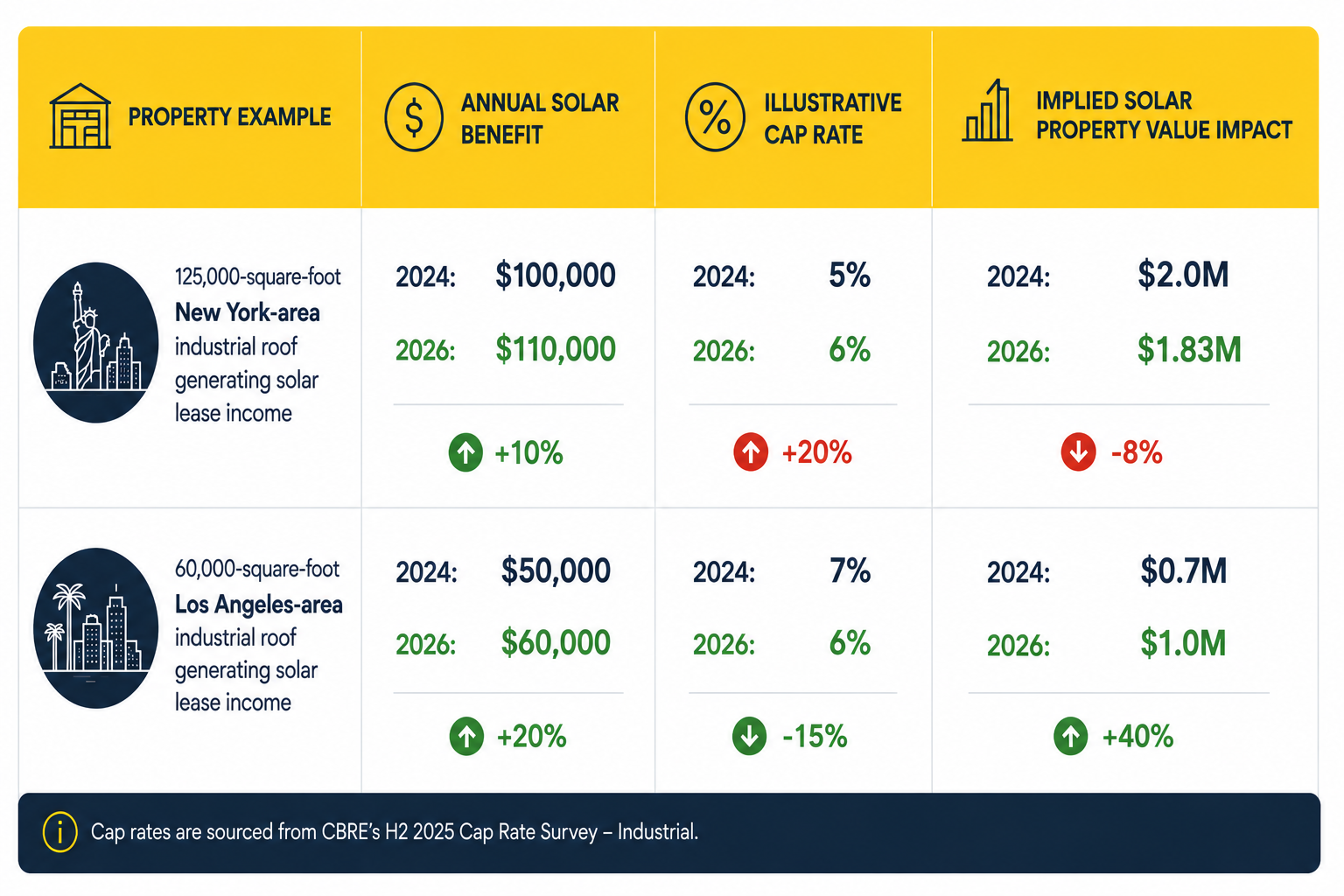
Net-net, our illustrative NY-area roof still adds $1.8M in implied property value due to solar in 2026 (down 8% from $2.0M in 2024) while our LA-area roof adds $1.0M in value, an increase of 40% vs. 2024’s $714K.
A second valuation approach discounts the projected lease cash flows over the contractual lease term rather than capitalizing the income. Applying this methodology to the same NY-area and LA-area lease assumptions, using a 20-year discounted cash flow with 3% annual lease escalation and an 8% discount rate, produces present values of approximately $1.35M for NY and $735K for LA.
Taken together, our NY-area property is gaining 5–7% in value at $218/square foot, while our LA-area property at $283/square foot gains 2–3%.
Battery storage is valued similarly. When structured as a lease to a third-party operator, the resulting income capitalizes into property value the same way solar lease income does.
As Anthony Saladino observed, a well-structured solar lease can function much like a quality long-term tenant, generating predictable, transferable cash flow while preserving the flexibility owners need to refinance or sell. That’s ultimately why solar and storage can create lasting value - not because they’re green but because they strengthen the economics of the property itself.
"If structured properly, a solar lease functions much like a quality long-term tenant..."
Watch Anthony Saladino, Plymouth Industrial REIT President & CFO, explain why project structure, not just economics, determines whether solar enhances or hinders future property value.