For commercial real estate owners, the question isn't whether battery storage offers opportunities. It's where those opportunities make the most financial sense across a portfolio.
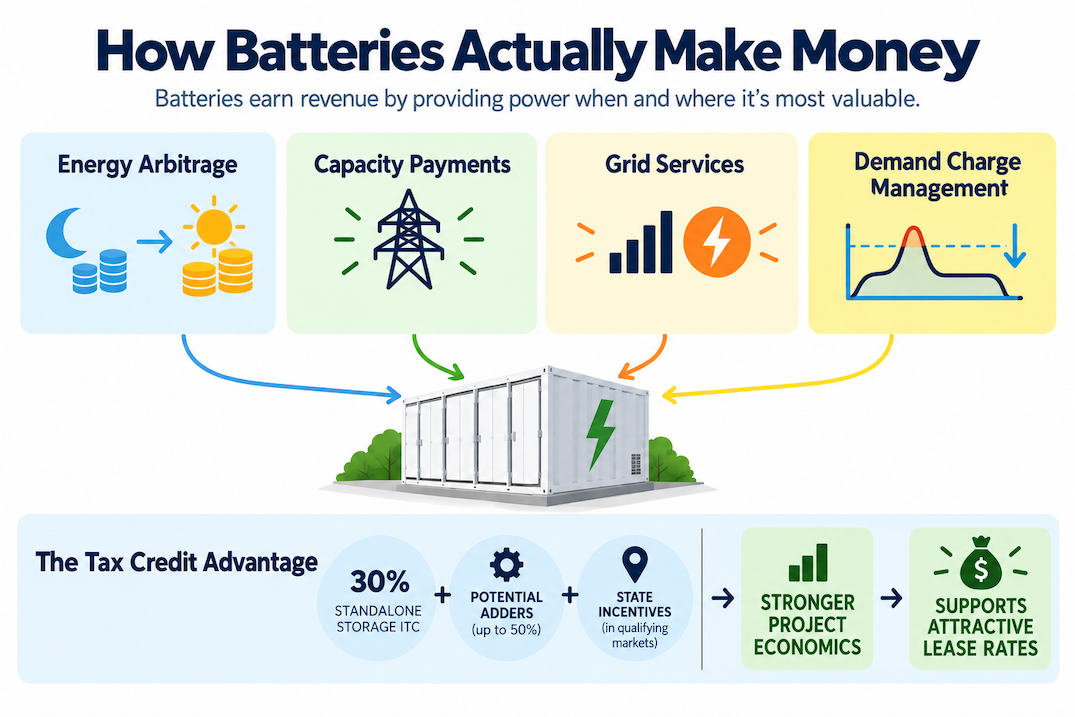
In the latest chapter of our Battery Content Series, we covered “Battery Economics 101: How Commercial Batteries Actually Make Money,” highlighting the different ways a commercial battery can create value: demand charge management, energy arbitrage, demand response, capacity programs, incentives, and, depending on the project, participation in broader grid markets.
Hopefully, by now, you’re convinced (or at least humoring us) that batteries are an attractive opportunity and are ready to get in the game.
Now we're stepping up to the plate to answer the next question: Which properties offer the best chance of hitting a home run?
Battery storage can be financially attractive on its own in certain markets, but in 2026, state and utility incentives remain critical to making many projects economically viable. That's why identifying the right markets is the first step toward a successful investment. To begin to belabor our baseball metaphor, why swing for the fence when there's a short porch down the right-field line? In battery storage, knowing where to aim first can make all the difference.
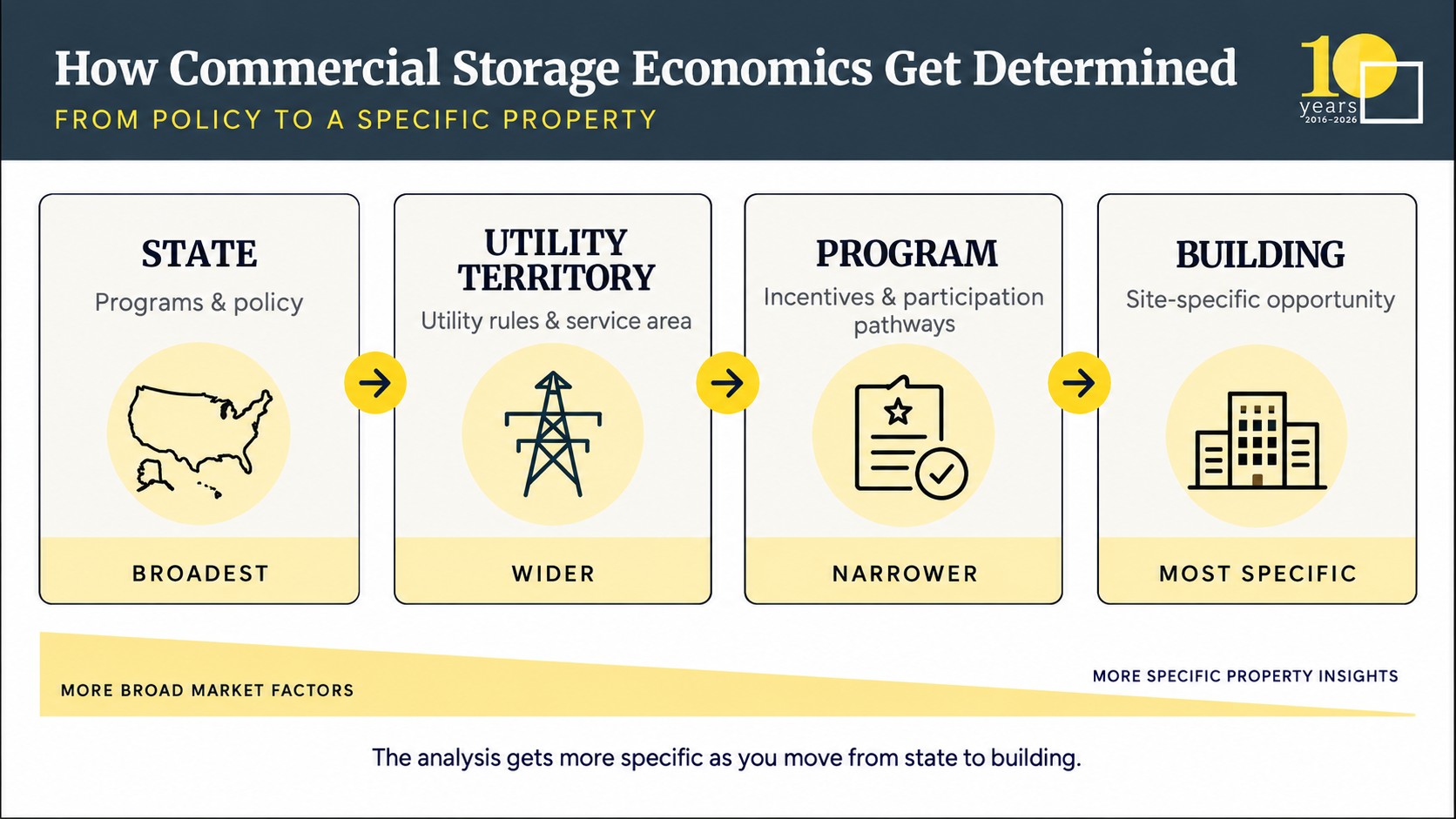
There are four levels through which we evaluate an opportunity. From biggest to smallest, there is:
State → Utility Territory → Program → Building
As mentioned, batteries can be accretive in a few states, and with large national portfolios, it’s critical to know where the best economics are to prioritize allocation decisions.
Picking the right state has the largest bearing on the opportunity set; each state has a different incentive structure that drastically affects both the battery use case (i.e., behind-the-meter vs. front-of-the-meter) and overall project economics.
Here’s SolarKal’s list of top BESS states for 2026–2027 (yellow represents established programs, and teal represents imminent programs).
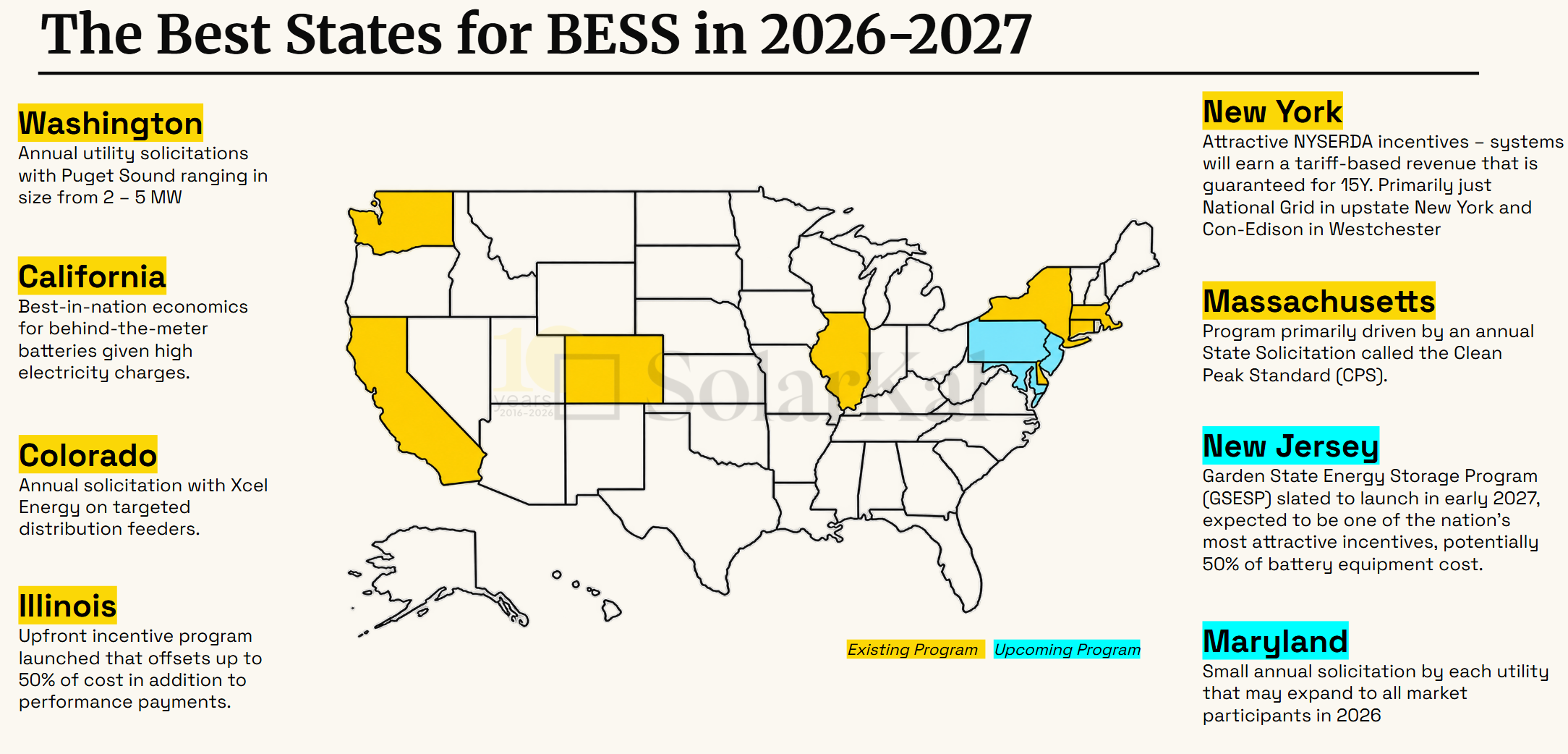
Illinois, for example, has moved quickly over the past year to incentivize batteries. The state's 2026 Clean and Reliable Grid Affordability Act has created a promising battery storage market, with new incentives that can offset up to 50% of project costs.
New Jersey is also emerging as a promising battery storage market. The state's Garden State Energy Storage Program (GSESP) is expected to offer significant new incentives for both behind-the-meter and front-of-the-meter projects, making it a market worth watching closely.
California offers a different kind of opportunity. Even without major storage incentives, high electricity prices and peak-hour demand charges make batteries financially attractive. By storing energy when rates are low and using it when rates spike, commercial property owners can achieve significant savings.
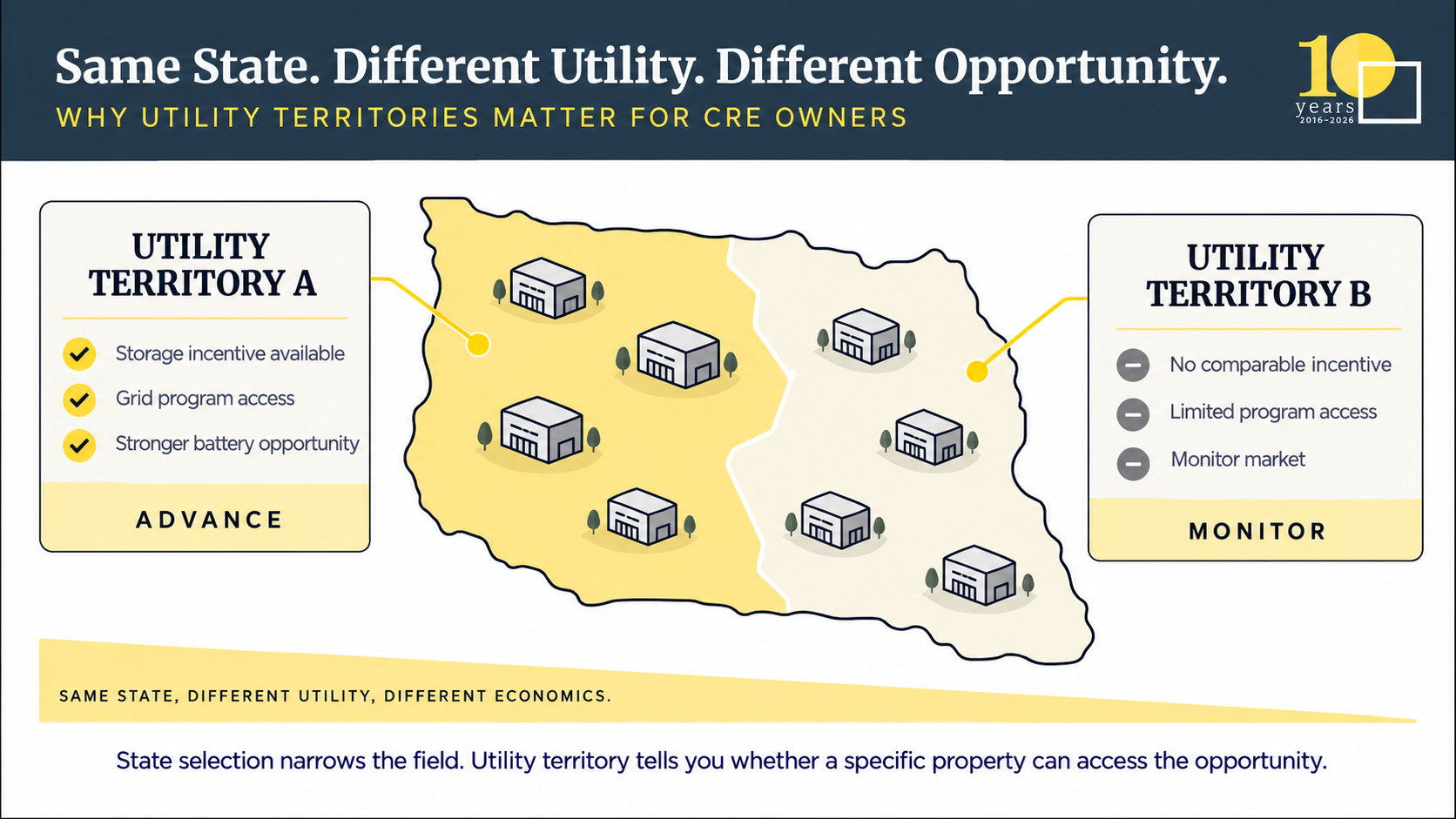
Even within the same state, battery economics can vary significantly by utility territory. Different electricity rates, incentive programs, and grid requirements can change the financial outlook from one property to the next.
For portfolio owners, identifying the right utility territories helps narrow the field to properties with the strongest potential.
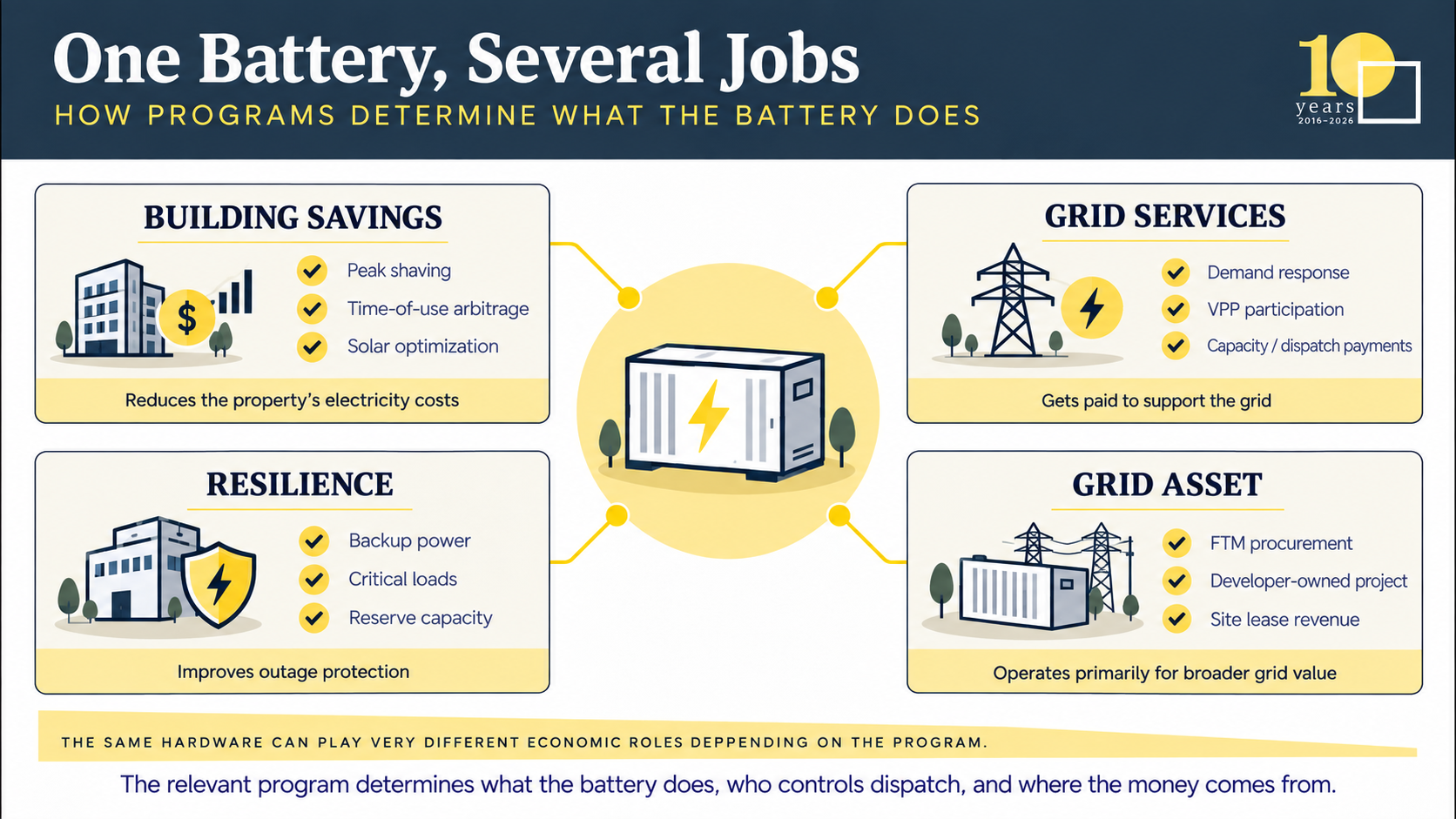
Once a battery is installed, there are several different ways to put it to work - a different swing for a different pitch.
The right strategy depends on how the battery will generate value. Behind-the-meter systems can lower electricity costs, provide backup power, and earn revenue from grid services. Front-of-the-meter systems operate independently of the building, allowing property owners to generate lease income without managing the battery.
We explored the revenue stack in detail in our “Battery Economics 101” article, showing how some of these revenue opportunities are not always mutually exclusive. The operating strategy is usually controlled through the battery’s Energy Management System, which determines how those priorities are balanced and optimized for your use case.
A battery might reduce demand charges on a normal summer afternoon, participate in a utility dispatch event later that day, and/or maintain a minimum state of charge for backup power. That is why the specific program matters so much. It establishes what the battery is allowed or required to do, when it has to do it, and how it gets compensated.
Once the market, utility, and program all line up, the analysis finally gets down to the property itself. For a first-pass review, we are usually trying to answer a handful of practical questions before spending meaningful development dollars - the earlier a site can be de-risked, the better.
Does the energy usage on-site justify a behind-the-meter system?
Typically for behind-the-meter battery economics to make sense for the parties involved, you’ll want to have enough energy usage on-site to justify the investment. SolarKal helps its clients parse through interval data to determine where the best opportunities are.
Is there enough usable space?
Battery systems need more than just room for the equipment. They also need appropriate setbacks, fire access, electrical equipment, and room for construction and maintenance. For larger front-of-the-meter systems, that footprint can become meaningful, so excess land or underutilized parking areas are often the first places we look.
Does the layout actually work?
The best-looking open area on an aerial image is not always the best battery location. Flood zones, wetlands, slopes, nearby residences, existing buildings, drive aisles, loading operations, and access requirements can all materially affect siting. In addition, losing parking spaces, interfering with truck circulation, creating noise near occupied areas, or limiting future development can quickly outweigh an attractive battery lease or savings opportunity.
Can it connect to the grid?
A good site still needs a viable electrical path. Available feeder capacity, proximity to electrical infrastructure, and utility interconnection requirements can determine whether a project is straightforward, expensive, or simply not worth pursuing.
Do the economics still work?
Only after those physical and electrical questions are answered can you really judge whether the incentive, grid revenue, lease payment, or utility savings justify moving forward.
The good news is that most of this can be screened relatively quickly. We’ll be going deeper about site qualification later in our series.
For a large portfolio, the goal is not to fully engineer every property. It is to eliminate the obvious misses, identify the sites where the market opportunity and physical characteristics line up, and reserve detailed engineering and interconnection work for the handful of properties that deserve it. That's exactly how SolarKal helps our commercial real estate clients prioritize battery storage opportunities across their portfolios.
That is why the screening process matters so much. The best projects are usually not the ones where an owner tries to force storage onto every building in a portfolio. They are the ones where the right market conditions, the right utility territory, the right program, and the right physical site all line up.
Introducing the SolarKal Battery Content Series
Battery storage is the most important next step in the evolution of commercial energy.
Our goal is to continue injecting transparency into a rapidly evolving market -demystifying BESS so commercial real estate owners can separate hype from opportunity and make better investment decisions.
Missed earlier articles? Here are the links: